
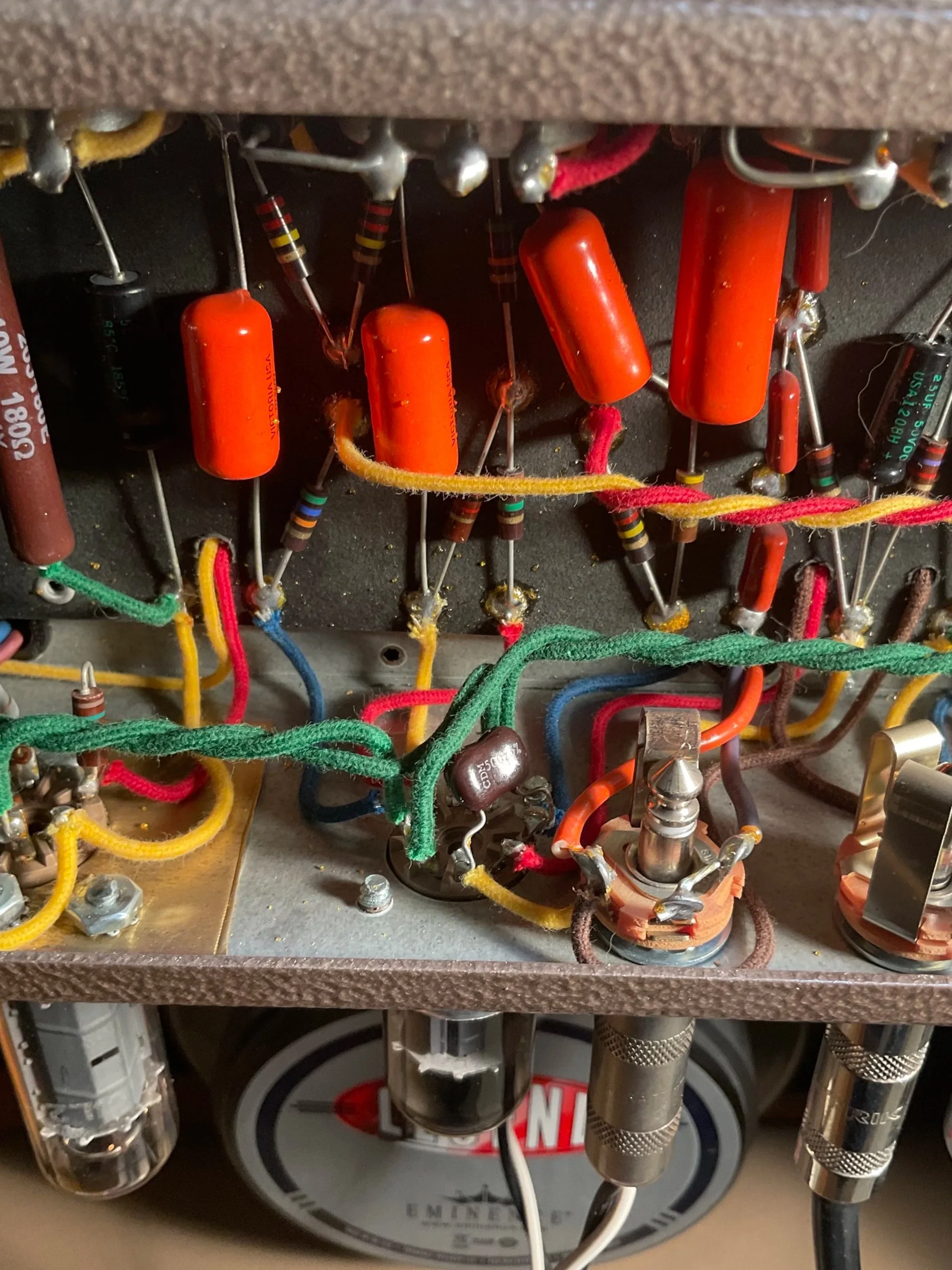
Victoria Amplifiers, a DIY experiment gone right.
By: John Pope
As the owner and operator of a vintage amplifier repair shop I have been blessed with the experience of servicing hundreds of amplifiers, from vintage Fenders to Two-Rocks from Peavy Classic 30’s to McIntosh. Some amplifiers are better made than others, some sound better than others, some have unique features or voicings, I particularly enjoy the vintage Fender amplifiers made between the 1950s and 70s. To my ear they are the sweetest and most musical sounding amplifiers available, I also like Matchless amplifiers and once played a Tone King that knocked my socks off - but when people ask me which new amplifier company to look into I always say Victoria.
Victoria Amplifier Company stands out. Their original designs and faithful recreations of classic Fender amplifiers have been noted by many to be of the finest quality. their hand-built construction and haunting tones have attracted the attention of critics, guitar players, and professionals worldwide. There are, after all, plenty of companies building boutique amplifiers. Very few, however, have gone to such extraordinary lengths to recreate not only the circuits, but the very ingredients that gave the originals their voice.
Owner Mark Baier was on the vanguard of the tube revival of the 1990s…
Since the 1970s, hi-fi tube aficionados had gathered in private, quietly recreating America's monumental tube circuits of the 1930s and '40s. They believed these antiquated designs were, in many ways, superior to the modern transistor circuits that had replaced them. They pieced back together legendary American theater sound systems and built tube amplifiers for themselves and their friends.
By the 1990s, the tube renaissance was in full force, and small networks of enthusiasts created publications like Joe Roberts' Sound Practices, a small journal of DIY hi-fi experiments and articles written by gurus like Herb Reichert, MagneQuest's Mike LaFevre, Electra-Print's Jack Elliano, and even Vincent Gallo, who wrote an ode to monophonic playback, "Mono Mia" (Sound Practices, Issue No. 1).
While the hi-fi world was busy rediscovering Western Electric, RCA, Altec, and other forgotten American masterpieces, a similar revival was quietly beginning in the guitar amplifier world. Mark Baier's journey would become part of this same movement: a search for the lost sounds, materials, and craftsmanship of an earlier era.
At that same moment in time, Mark Baier, founder of Victoria Amplifier Company, had just landed a job as a stockbroker in Chicago. For the first time in his life, he was able to afford a brand-new Fender amplifier—a '59 Bassman® Reissue, to be exact—and he thought he was in for a treat and a major upgrade from his original 1959 Fender Bassman. What he found was a brittle, stale-sounding amplifier full of plastic and modern components, nothing like what Fender used to use.
What followed wasn't simply an attempt to build a better amplifier. It became an investigation. Why didn't it sound the same? What had changed? The answer, Mark discovered, wasn't one thing. It was everything.
Unknowingly, Mark's journey now paralleled that of the DIYers recreating hi-fi tube amplifiers from the past. He became obsessed with recovering the sound of his original vintage Fender amplifier, quit his job, and spent $250,000 on the last batch of Allen-Bradley resistors the company produced before ceasing production of the famed carbon-composition resistors used by Fender, McIntosh, and practically every American audio electronics company for half a century. That same batch of resistors is still being used today to build Victoria amplifiers.
Early on, Mark realized the output transformers available on the market were not sufficient for recreating the tone of vintage amplifiers. After a goose chase of phone calls to Fender and Triad Transformer Company (now Triad Magnetics), the company that built transformers for Fender in the 1950s, Mark received a mysterious phone call from a former Triad employee who revealed he was the only person with the original Fender transformer specifications. He mailed Mark the documents, and BANG!. Mark now had the literal recipe for Fender transformers, complete with handwritten notes from Fender demanding certain characteristics from the transformers. Mark found a transformer supplier willing to reproduce them to the original specifications using period-correct materials.
These are only two of the countless decisions that separate a Victoria amplifier from the ordinary.
Too many of today's boutique amplifiers are, in effect, carefully assembled kits built from excellent off-the-shelf components—and many of them are genuinely outstanding amplifiers. This is not to diminish their work. But the experience of playing, hearing, or even removing the back panel of a Victoria amplifier is something altogether different. It is immediately apparent that nearly every component has a story behind it, a reason for being there beyond simple availability. Many modern amps simply sound the same. They are a sum of parts, and many use the same, or slight variations of the same components.
But nothing sounds quite like a Victoria Amplifier, and that's really the point. Many modern amplifiers inevitably converge toward the same handful of readily available components and similar design choices. Victoria, by contrast, was never built around convenience. It was built around rediscovery. Mark's stockpile of vintage Allen-Bradley resistors, custom-built transformers, carefully specified capacitors, wiring, and speakers are not marketing features; they are the product of decades spent chasing a sound that most people assumed had been left behind in the 1950s.
Victorias shop is small and every amp is hand built, many are custom ordered to the players specification. Think, a brown Princeton with reverb or a Deluxe Reverb with Princeton tremolo, at Victoria the combinations are endless.
Every Victoria amplifier is, in a sense, a continuation of an unfinished conversation between Leo Fender and the craftsmen who built the originals. In the 2000s, Fender actually commissioned Mark to design the “ultimate guitar amplifier”, he ultimately kept the design for himself and now produces many original amplifier designs to complement his recreations. The Golden Melody (played by Bob Dylan), Silver Sonic, Electro King (played by Jeff Tweedy), and the Reverberato effects unit (played by John Mayer, Trey Anastasio) being prime examples.
In a world of assembly lines, solder baths and barcodes, this author is relieved to experience the manufacturing quality and sound of Victoria’s American made amplifiers.